Status: Initial Data Processed
Last Updated: February 20, 2026

1. Executive Summary
We analyzed over 440,000 citizen-initiated 311 Service Requests to track how often residents are reporting unauthorized encampments and requesting city sweep interventions. The data reveals a distinct seasonal pattern, highlighting the ongoing challenge of managing unsheltered populations during the peak summer months.
2. Data Cleanup & Methodology
The raw data was sourced directly from the Denver Open Data Catalog (311 Service Requests), covering the trailing 12-month period from February 2025 through January 2026.
Because the 311 database includes everything from pothole complaints to property tax inquiries, we applied strict programmatic filters using Python (pandas) to isolate homelessness-related infrastructure requests:
- Initial Dataset: 440,854 total service records.
- Target Categories: We filtered the
Case Summarycolumn exclusively for tags including ‘Encampment Reporting’, ‘911 ENCAMPMENT’, ‘Homeless Encampments’, ‘Encampment / Street Engagement’, ‘Sweep Request’, and ‘Request to Begin Sweeping’. - Refined Dataset: This filtering isolated 9,489 unique citizen reports directly related to encampments.
- Temporal Grouping: The filtered records were aggregated by the
Case Created Dateinto monthly buckets to visualize long-term trends, intentionally dropping incomplete data for February 2026 to prevent chart distortion.
3. Key Observations
The Summer Visibility Surge
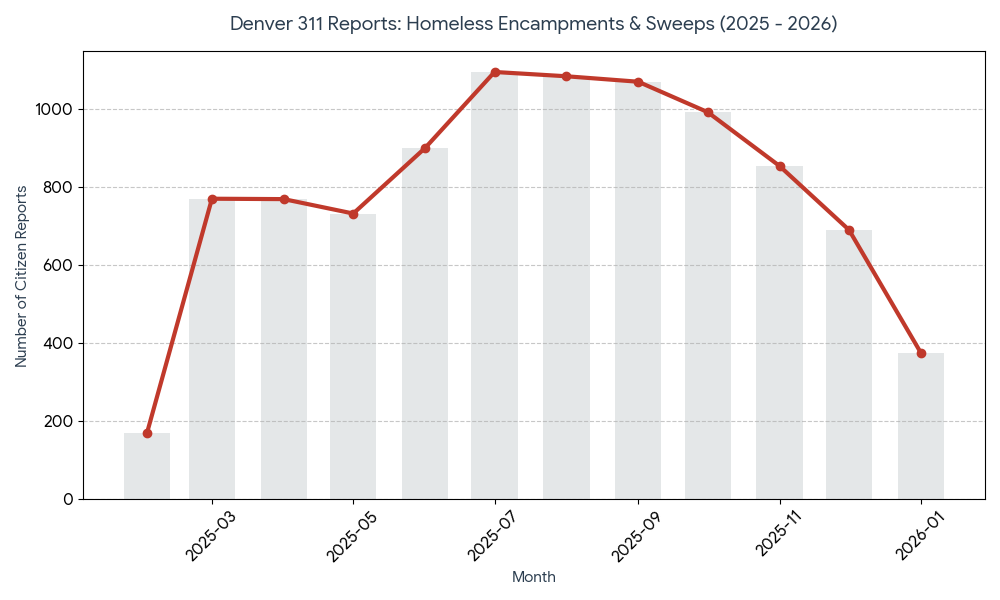
The data illustrates a dramatic increase in citizen reports as the weather warms. In the spring (March–May 2025), reports hovered around 750 per month. By July and August 2025, reports peaked at nearly 1,100 per month. This surge likely reflects two factors: an actual increase in outdoor, unsheltered camping during favorable weather, and a higher volume of citizens utilizing public outdoor spaces, leading to increased observation and reporting.
The Winter Drop-Off
Conversely, as temperatures drop, so do 311 encampment calls. By December 2025, reports fell to 689, and plummeted to just 374 reports in January 2026—roughly a 65% decrease from the summer peak.
What This Means for Policy
It is critical to note that 311 reports are a proxy for visibility, not a direct census of the unhoused population. A drop in winter reports does not necessarily mean homelessness has been “solved”; it more likely indicates that individuals have temporarily moved into cold-weather emergency shelters or are utilizing less visible survival strategies.
Evaluating the true success of Denver’s housing initiatives (such as the House1000 program and the expanded HOST budget) will require cross-referencing this 311 visibility data against the official Point-in-Time (PIT) census counts and actual housing retention rates. This will be the next step, stay tuned!

Leave a Reply